Shopify SEO services

We provide SEO services for Shopify stores - from baseline optimization to deep work on organic revenue. We understand the constraints of a SaaS platform and know how to deliver results within them, without trying to turn Shopify into something it isn't.

Shopify is a closed SaaS platform where SEO plays by its own rules. Knowing those rules is what gives you the edge over competitors

We break down your store, your Shopify plan, the theme version, and the competitive landscape - then build a growth strategy with concrete stages.

How Shopify's SaaS architecture shapes the SEO strategy

Shopify is fundamentally different from classic CMS - it's a closed SaaS platform where you don't control the server, don't have php access, and can't change the URL structure. These constraints shape a unique logic for SEO work.

Understanding these 8 points helps you plan the SEO budget properly and avoid burning hours on tasks Shopify simply won't let you do.

/ Platform plan
Your plan determines the SEO capabilities you get

Basic, Shopify, Advanced, Plus - Shopify plans differ in more than just price. Plus unlocks checkout customization, Scripts API, expansion stores for regions. On cheaper plans some SEO tasks are either off the table or need workarounds. Before planning, we assess your plan and whether keeping it or upgrading makes sense.

/ Liquid and themes
The theme determines what you can do with SEO

Shopify uses Liquid - its own templating language. Your theme either supports modern SEO capabilities (Online Store 2.0, schema markup, lazy load) or limits you to basic functionality. Older 1.0 themes and free themes like Dawn often need extra work. We audit your theme and give clear recommendations - whether to optimize or swap it out.

/ URL structure
Shopify won't let you change /products/ or /collections/

One Shopify quirk: the URL structure is hard-coded. You can't drop "/products/", "/collections/", or "/pages/" from the paths. That limits SEO, especially for brands that migrated from open platforms. We work within this structure and compensate with other SEO levers.

/ Duplicates via collections
One product - multiple URLs across different collections

Shopify generates URLs like /collections/all/products/example, /collections/sale/products/example. By default Shopify sets a canonical, but not always correctly - especially for smart collections with conditions. We fix the canonical logic through the theme and configure robots.txt.liquid (one of the few customization options available since 2021).

/ Apps Store
SEO apps affect speed and create duplication

The Shopify App Store offers thousands of apps, 200+ of them positioned as "SEO". Most duplicate functionality the theme already has, while adding JS code that hurts speed. We audit your active apps and tell you straight which ones to keep and which to drop with no loss in functionality.

/ Store speed
Shopify handles the hosting, but speed comes down to the theme

Unlike WordPress, you don't control Shopify's hosting - it's standardized and fast. But overall site speed comes down to the theme, the active apps, and background tracking scripts. Stores running 20+ apps rarely hold Core Web Vitals in the green zone without optimization.

/ Shopify Markets
Its own architecture for multilingual and multi-currency setups

Shopify Markets lets you spin up separate domains or subfolders for different countries - with their own currencies, languages, and prices. It's a powerful tool for international stores, but it needs a proper hreflang strategy and careful work on cross-region cannibalization. Without professional setup, Markets often hurts SEO instead of helping.

/ Analytics
Shopify Analytics isn't a replacement for GA4 and Search Console

Shopify's built-in analytics is convenient for a sales overview but limited for SEO analysis. Without properly configured GA4, Search Console, and theme-level conversion tracking, you won't see the real picture of organic. We set up the full analytics stack tailored to Shopify specifics.

The D&Team approach

Our experience with Shopify

We don't try to apply methods to Shopify that work on WordPress or OpenCart. A SaaS platform has its own rules, and working with it takes separate experience and a different toolkit.

/01/
We understand the constraints of Shopify's SaaS logic
We know what's possible within the platform and what isn't. We don't promise to change the URL structure or edit robots.txt in the classic sense. Instead, we make the most of the levers we do have - the theme, apps, Liquid, Shopify Markets - to squeeze the maximum SEO out of the given boundaries.
/02/
We work with Liquid and Online Store 2.0 themes
We have hands-on experience editing Shopify themes via Liquid code, configuring sections, schema markup, and product structured data. We don't learn on your dime - we get straight to work. We know how to upgrade an older 1.0 theme to 2.0 when it's justified, and when it's better to switch to a dedicated ecommerce theme.
/03/
Audit focused on Shopify specifics
A standard SEO audit doesn't work on Shopify - you have to check things that don't exist on other platforms: collections structure, smart collections behavior, Shopify Markets setup, analytics configuration. We run a full audit on 80+ parameters that are relevant specifically to Shopify.

Which stores we work with best

Shopify isn't a fit for every business. And not every Shopify store will benefit from our work. Here are the situations where the partnership delivers the maximum result.

Stores already on the Shopify plan or higher with steady ad-driven sales but weak organic traffic growth
Brands that migrated to Shopify from another platform (WooCommerce, OpenCart, Magento) and saw rankings drop after the move
Owners with complex collections and smart collections setups running into cannibalization or indexing problems
Businesses using Shopify Markets to enter 2+ markets that aren't seeing the organic traffic they expected from the new countries
Stores with a large catalog of 1,000+ products where the SEO app isn't delivering systematic results due to theme limitations
Brands running Google Ads and Meta Ads to a Shopify store who want to bring CAC down through organic

When SEO for Shopify won't deliver the expected results

An honest read on the situations where Shopify SEO won't justify the budget put in - or where the problem runs deeper than SEO and needs to be solved by other means.

A store on Shopify Lite or Basic with a small catalog - the SEO economics more often than not won't add up
The store launched less than 3 months ago - you need to build the first conversion funnel through ads first, then layer SEO on top
The brand sells products that globally move through Amazon or iHerb - building organic search to your own store is hard without strong brand demand
The owner picked a pretty free theme like Dawn or Refresh but isn't open to technical work on it - some SEO tasks will be blocked
Expecting results in 1-3 months - Shopify SEO typically shows first shifts around month 4-6, with systematic growth at month 7-10
A request for a guaranteed ranking - a reputable SEO agency doesn't give that kind of guarantee, especially in competitive D2C niches
The owner isn't ready to invest in content marketing - on Shopify, blog content is often the only real path to informational queries
A migration from Shopify to another platform planned within the next 6 months - investments in Shopify-specific work won't have time to pay off

Scope of work for SEO of a Shopify store

Specific work we deliver within the platform. Each item is a separate scope tied to Shopify's capabilities and your commercial goals.
/01/
Store technical diagnostic
  • assessment of the plan and available SEO capabilities
  • theme audit (Online Store 2.0 or 1.0)
  • analysis of active apps for duplication and speed impact
  • check on collections, smart collections, canonicals
  • prioritized 6-month work plan
/02/
Theme work through Liquid
  • optimizing sections and templates structure
  • rolling out Schema.org Product with the full attribute set
  • H1-H6 optimization on product, collection, and page templates
  • removing redundant Liquid code that drags speed down
/03/
robots.txt.liquid and canonical setup
  • editing robots.txt via Shopify Admin or Liquid
  • canonical control for duplicates from collections
  • handling smart collections to avoid thin URLs
  • proper treatment of ?variant= parameters
/04/
Semantic core and keyword research
  • commercial and informational queries by topic
  • mapping between collections, products, pages, blog
  • long-tail discovery for product pages
  • niche seasonality and trend analysis
  • a query-to-page mapping matrix
/05/
Shopify Markets configuration
  • building a hreflang matrix for every market
  • removing duplicates between regional domains
  • geo targeting through Search Console
  • controlling currency versions and their SEO impact
/06/
Speed and Core Web Vitals optimization
  • auditing active Shopify Apps for JS overhead
  • image optimization at the theme level
  • lazy load setup for product pages
  • hitting the green Core Web Vitals zone
/07/
Work on product pages
  • rewriting descriptions for the top 100 products
  • image and alt-tag optimization
  • extended schema markup with reviews and pricing
  • working with product variants for long-tail queries
/08/
SEO content through the Shopify Blog
  • a content plan tied to informational queries in your niche
  • SEO articles that drive readers to collections and products
  • refreshing older posts to match current semantics
  • internal linking to the product catalog
/09/
Analytics and tracking setup
  • GA4 setup with ecommerce tracking
  • Search Console for every Shopify Markets domain
  • a rankings dashboard updated weekly
  • organic conversion tracking tied to revenue
/10/
Link building for Shopify stores
  • competitor backlink profile analysis in your niche
  • outreach strategy tailored to D2C and ecommerce projects
  • work with product reviews and guest posts
  • monitoring anchor distribution and donor quality

Workflow sequence on a Shopify project

Each stage builds on the result of the previous one. Without an audit there's no proper strategy, and without a strategy technical fixes won't produce a cumulative effect.

7 stages from the first meeting to systematic results in traffic, conversions, and store revenue.

/01
/02
/03
/04
/05
/06
/07
/01
/ Briefing and a deep dive into the store's business

The first meeting is a full deep dive into your store: brand goals, current customer acquisition channels, the assortment, margins on key products, sales geography. SEO without understanding the business's commercial context won't drive revenue.

/02
/ Plan check and store configuration review

Before running the full audit, we review your Shopify plan, active apps, theme version, and Shopify Markets configuration. This step gives a realistic read on the SEO levers and constraints available.

/03
/ In-depth SEO audit with a Shopify focus

A full audit that accounts for the platform's specifics: collections, smart collections, canonicals, Liquid code, apps, multilingual setup, analytics. The output is a report with prioritized tasks and a forecast for each one.

/04
/ Aligning on strategy and priorities

Based on the audit and the semantic core, we shape the growth strategy. We align with you: what to change in the theme, which apps to remove, whether to upgrade the plan, what sequence of work to follow over the next 3 months.

/05
/ Removing critical SEO constraints

The first 4-6 weeks are about closing what's blocking SEO: Liquid work, canonical setup, Schema.org fixes, speed optimization, hreflang configuration for Shopify Markets.

/06
/ Ongoing content and authority work

We launch the ongoing work: SEO copy for collections, rewriting product pages, regular blog articles, link building through outreach. This stage runs continuously and brings the bulk of the traffic gains.

/07
/ Regular metric review and plan adjustments

Each month - a report on actual results with the plan for the next period. Once a quarter - a strategy meeting where we revisit the bigger calls: is the current theme still right, do we add new markets through Shopify Markets, what to add to the scope.

What you get from Shopify SEO services

As a result of SEO services, your Shopify store becomes a fast, technically sound, and well-structured tool for traffic and sales acquisition.

You get a store that takes full advantage of Shopify and doesn't suffer from the platform's typical pitfalls.

01
Shopify theme optimized to current SEO standards
02
Noise from redundant apps removed without loss of functionality
03
Schema.org markup in place with rich snippets in the SERP
04
Shopify Markets configured with proper hreflang
05
Steady month-over-month organic revenue growth
Our pricing

SEO service
pricing plans

Our pricing plans are based on a simple and transparent model: every client receives the same high level of SEO services, and the only difference between plans is the number of hours our team can dedicate to your project each month.

You choose the scope that matches your goals and growth pace

/01/ SEO Starter
Suitable for small projects and corporate websites
/02/ SEO Growth
Ideal solution for mid-size online stores and corporate websites
/03/ SEO Pro
For large online stores, SaaS platforms, and large content portals
SEO Starter
20 hours / 25$
500$/mo
This plan includes:
Small project (landing page, corporate site, small business)
Basic initial technical SEO audit + quarterly checks
Keyword research up to 100 keywords + basic content strategy
On-page optimization of priority pages
Basic linkbuilding (guest posts)
Rank tracking for TOP-50 keywords
Google Analytics 4: setup + monthly analytics
Communication via chat + monthly report
Suitable for landing pages, corporate websites, and small businesses that require basic SEO optimization and systematic work on organic growth. The team conducts an audit, optimizes key pages, works on technical factors, and builds a foundation for stable website development. The package budget covers team work only. Link placement costs, copywriting, and other expenses are paid separately by the client for full transparency.
SEO Growth
40 hours / 25$
1000$/mo
This plan includes:
Corporate site or online store
Full technical SEO audit + monthly technical monitoring
Keyword research up to 500 keywords + topic clusters + detailed content strategy
Full on-page optimization + template-based optimization
Linkbuilding: guest posts + niche edits + crowd + analysis of 3 competitors
Rank tracking up to 500 keywords + competitor comparison
Google Analytics 4 + comparative analytics across periods
Communication via chat + monthly report + 1 Meet call per month
This plan is designed for mid-size online stores and corporate websites that require consistent SEO work. The team focuses on technical optimization, site structure, content development, and link building to drive steady growth in organic traffic and sales. The package budget covers team work only. Link placement costs, copywriting, and other expenses are paid separately by the client for full transparency.
SEO Pro
70 hours / 25$
1750$/mo
This plan includes:
E-commerce, SaaS or highly competitive niche
Extended technical SEO audit + monthly monitoring + competitor analysis
Unlimited keyword research + pillar pages + full content roadmap
On-page + template automation + AI-friendly markup
Linkbuilding: tier-1 outreach + competitive link-gap for 5+ competitors
Unlimited rank tracking
Google Analytics 4 + custom events and conversions
Communication via chat + 2 Meet calls per month + quarterly strategy
This plan is designed for large online stores, SaaS platforms, and content-driven websites in competitive markets. Our team implements a full-scale SEO strategy including technical optimization, site structure development, content growth, link building, and analytics to drive sustainable traffic and business growth. The package budget covers team work only. Link placement costs, copywriting, and other expenses are paid separately by the client for full transparency.

Ready to grow your Shopify store through organic search?

Book a free preliminary meeting. We'll look at your Shopify store's visibility together, assess the potential in your niche, and point out the fastest growth opportunities visible from the initial analysis. If we see that SEO isn't the main solution in your case - we'll tell you straight.


The first meeting is always free. We start working together only when both sides see the potential.

Our case studies

Our team combines expertise, strategy, and AI technology so every project delivers a predictable result.
/01/
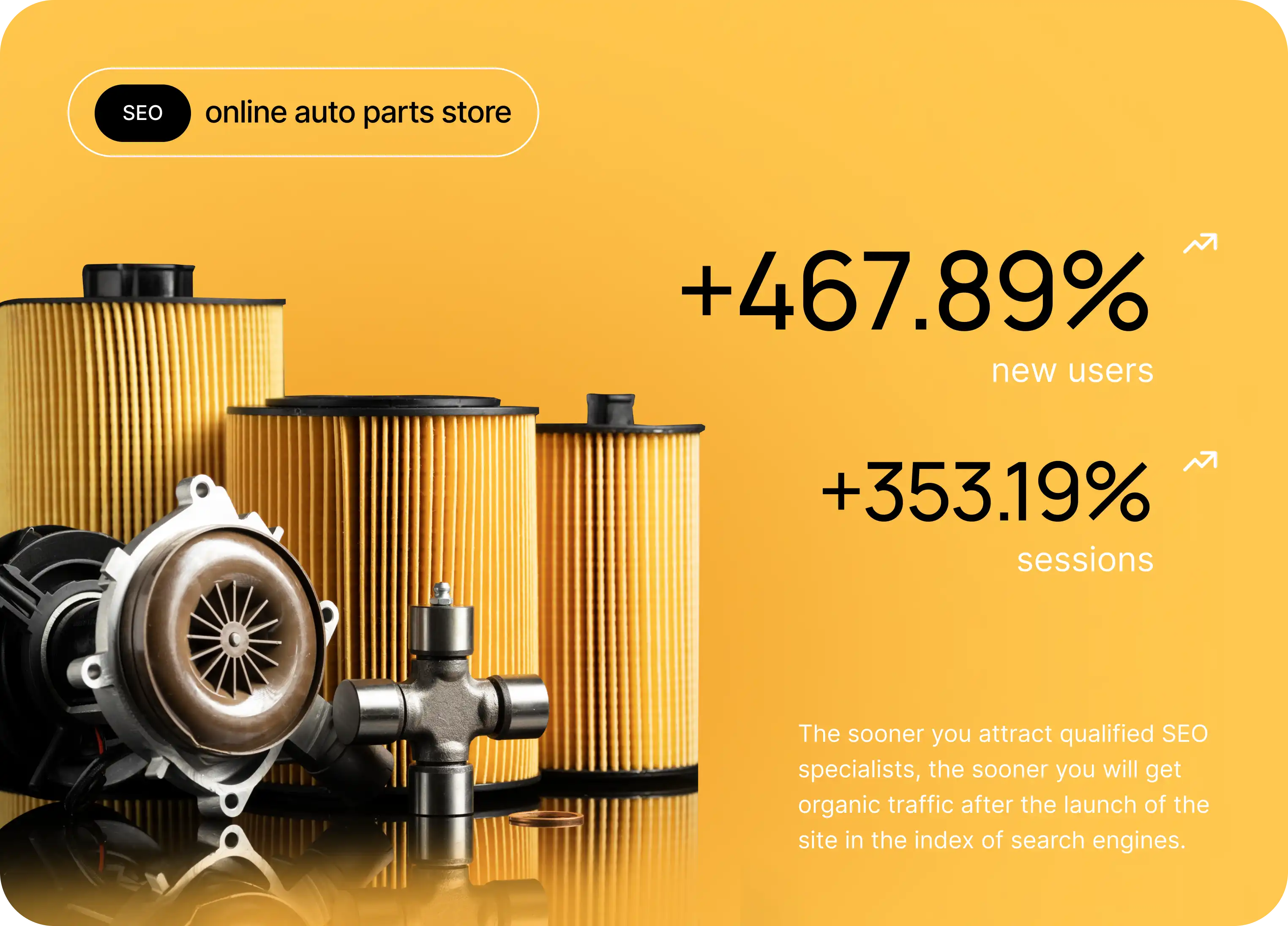
E-commerce SEO Case Study: Auto Parts Store
Auto Parts
Auto Parts
Auto parts store SEO case study: how a smart site structure, a strong semantic core, and step-by-step optimization of hundreds of thousands of pages delivered steady organic traffic.
Case details
/02/
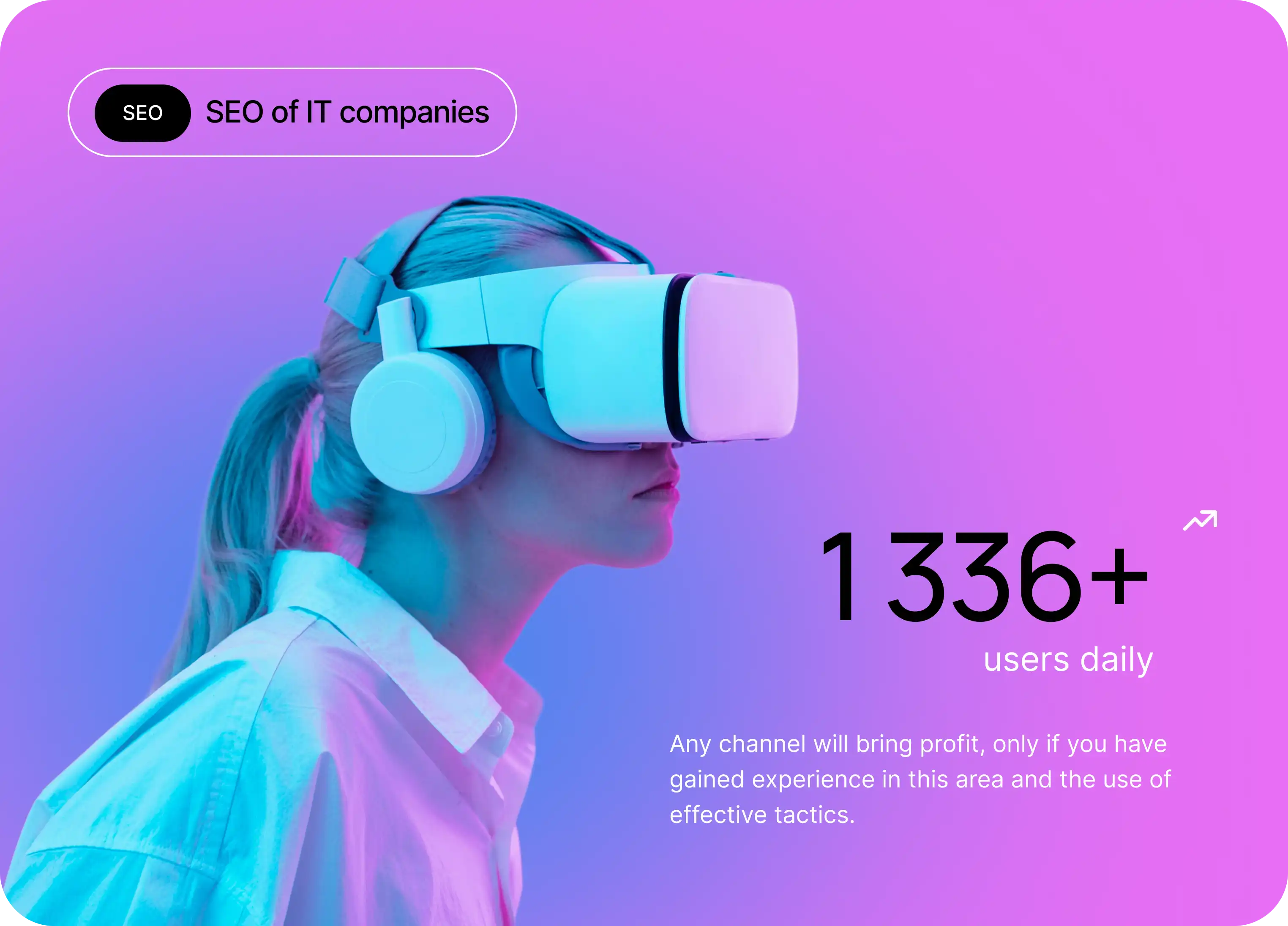
SEO for IT Companies: Case Study
IT company
IT company
First, let's clarify what makes an IT company different from a regular one. Can you call any company that uses computer technology in its work an IT company?
Case details
/03/
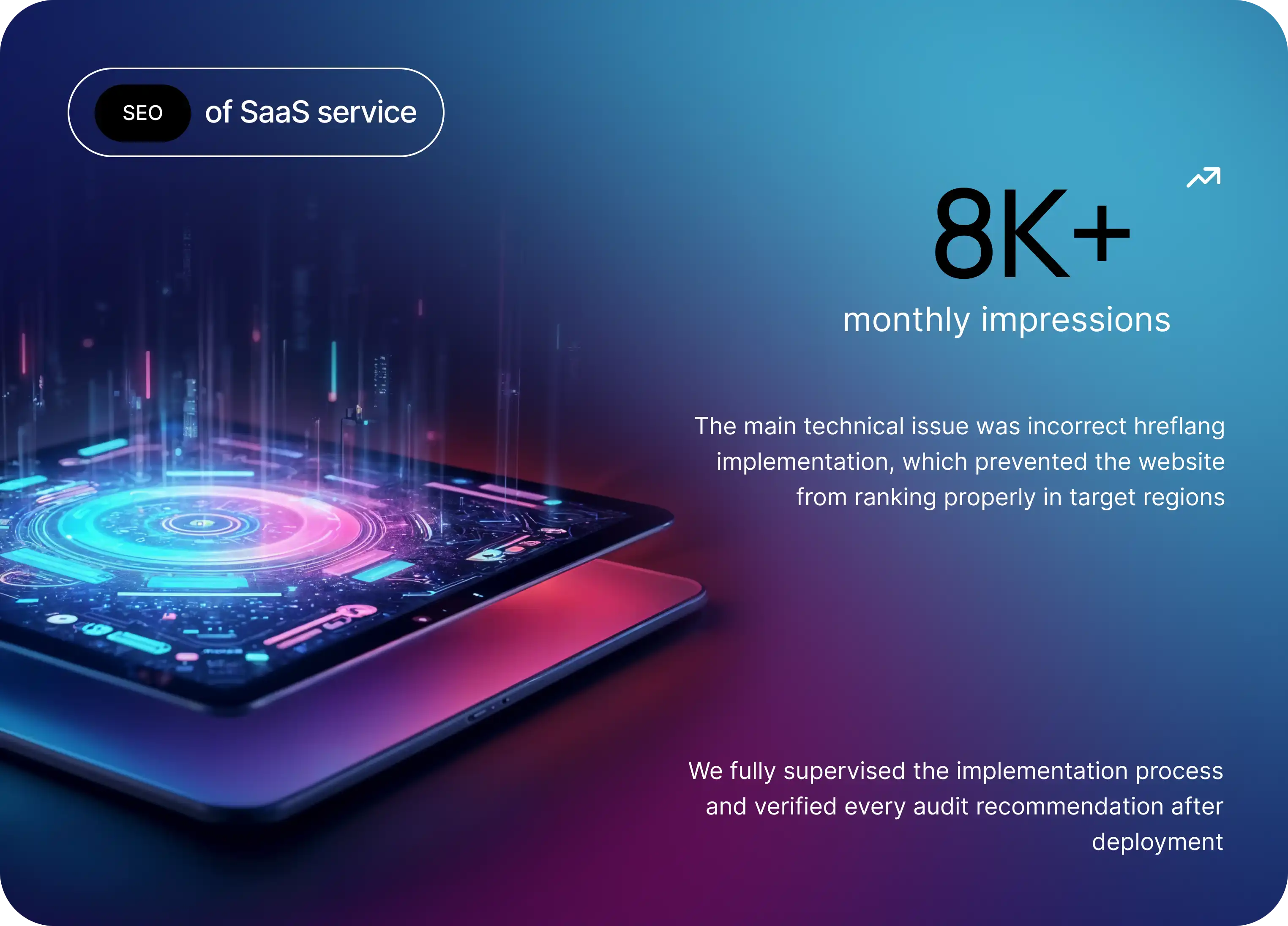
SaaS SEO Case Study: Promoting a SaaS Service Internationally
SaaS
SaaS
SaaS SEO case study: how a full technical audit, hreflang setup, and a steady backlink strategy helped an international SaaS service grow in Norway, the US, and the UK.
Case details
/04/
Cosmetics SEO Case Study: An Online Store Success
Cosmetics
Cosmetics
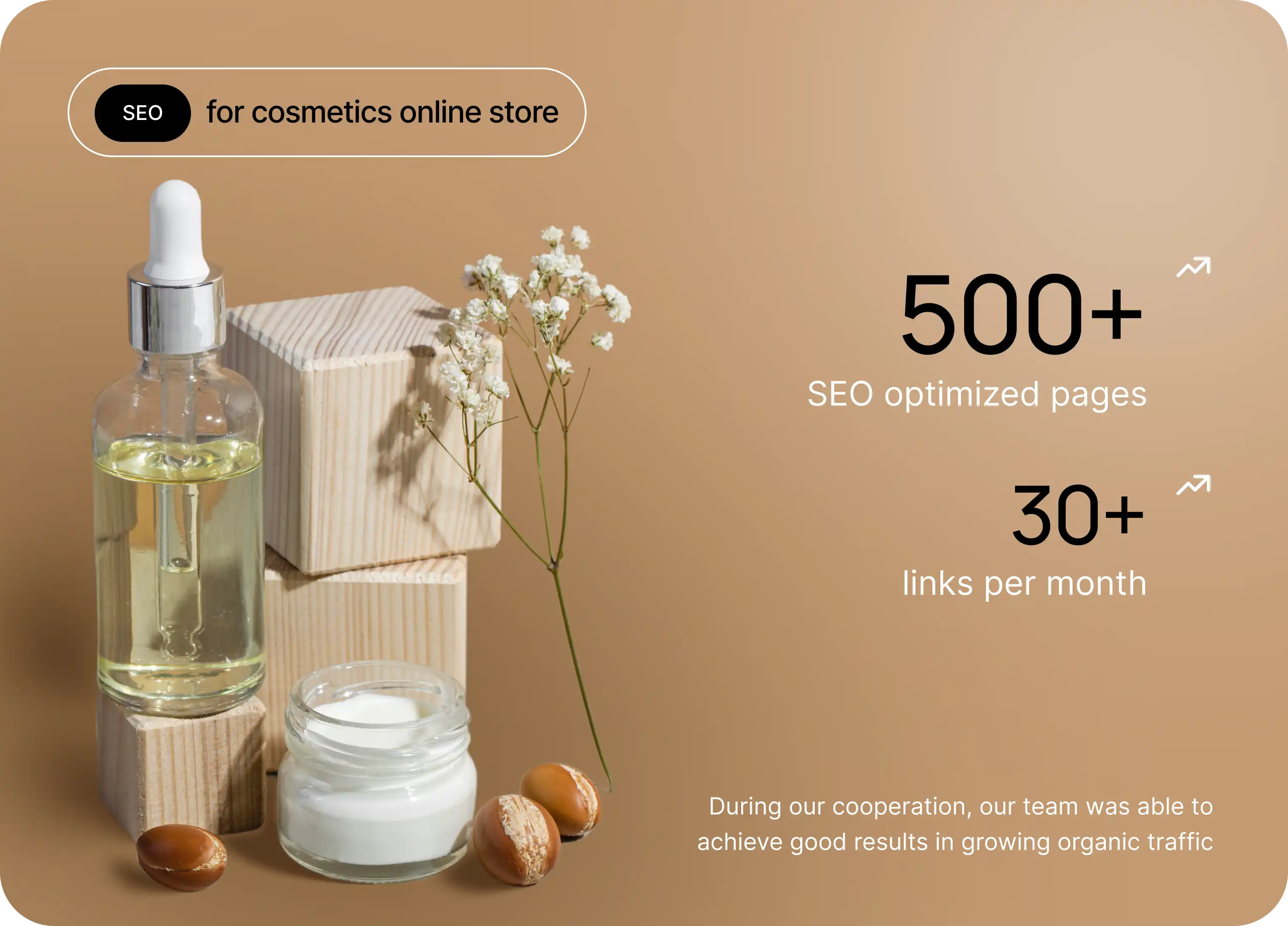
Cosmetics online store SEO case study: technical audit, optimization of 500+ pages, and a steady backlink strategy delivered solid growth in organic traffic.
Case details
/05/
Google Ads Case Study: Auto Accessories Store, 485% ROAS
Auto accessories
Auto accessories
Case details
/06/
Google Ads Case Study: Mattress Online Store, 448% ROAS
Mattresses
Mattresses
Case details
Team

Our experts

At D&Team, we've brought together specialists who help businesses grow online every day. Our SEO experts, PPC specialists, analysts, and developers work as a unified team to deliver a steady stream of targeted traffic and measurable results.
Anastasiia
/PM manager/
Manages projects and coordinates the team to ensure effective strategy execution
Vyacheslav
/SEO Specialist/
SEO expert with 6+ years of experience in digital marketing and online growth
IIryna
/PPC specialist/
Paid traffic specialist managing high-performing advertising campaigns
Oleksii
/Developer/
Develops and improves website functionality, ensuring stable performance
Dmytro
/CEO & Founder/
Defines the agency’s growth strategy and oversees key areas of development
What our clients say

Client testimonials

We value transparency and open feedback. Below are testimonials from companies that chose D&Team as their partner.
We've worked with D&Team for over five years. For me they're not just a contractor or outsourcing - they're my team, just in a different office. Highly recommend.
Kareryna
/Marketer at Alfatech/
Our requirements change - and D&Team changes right along with us; we've found a reliable partner we trust.
Oleh
/Founder of Modulex/
In two years D&Team brought 80%+ of our keywords into the top and set up our ads effectively - highly recommend.
Yuliia
/Director of Versal beauty salon/
Very talented and experienced guys. I enjoyed working with them. Their communication was top-notch, they met all deadlines, and their skills were quite strong. We will continue to work with D&Team. I recommend them if you need an expert in Google CPC and SEO.
Aram Karapetyan
/CEO nftdroops/
I have been working with this team for a long time and am completely satisfied with their work. During our collaboration, they have helped take the website to a new level. I recommend the D&Team for collaboration.
Olga
/Shop owner/
A professional team with an honest and transparent approach to work. During our cooperation, we received many useful recommendations and clear explanations regarding the website’s development. Their expertise and responsibility for results are clearly noticeable.
Fabio
/IT manager/
D&Team are good SEO specialists. They did a good technical SEO audit of the site and turned it in on time. I recommend their cooperation.
Vlad
/Developer/

We use
only proven tools

Frequently asked questions

Below you'll find answers to the most common questions worth reviewing before we start working together
Is upgrading from Basic to Shopify Plus worth it for SEO?

It depends on the store. Plus unlocks checkout customization, Scripts API, expansion stores, and has a direct SEO impact for large international brands. For stores with under $1M in annual revenue, the Shopify plan is usually enough. Plus costs $2,000+ per month, so the economic case has to stand on more than SEO alone. In the audit we tell you straight whether an upgrade is justified in your specific case.

Can we change the URL structure in Shopify - drop /products/ or /collections/?

No. This is a hard platform constraint that can't be changed even on the Plus plan. Every Shopify store shares the same path structure. It does limit SEO, but it also simplifies migration between stores and protects against mistakes. We work with what we have and compensate for the constraint with other SEO levers.

Which Shopify theme is best for SEO?

There's no single "best" theme - only themes that fit your goals. Free themes like Dawn, Refresh, and Crave work well for smaller stores and come with solid baseline SEO. Paid themes (Shrine, Impulse, Empire) give you more functionality for larger catalogs. If the store is on an older 1.0 theme - usually it's better to migrate to 2.0 with customizations than to try to straighten out the old code.

How do you handle duplicates from collections?

Shopify sets a canonical to the main product version by default, but not always correctly for smart collections. The strategy: we check every product for the right canonical, configure robots.txt.liquid to control collection indexing, and clear out junk parameter combinations. Sometimes the theme's Liquid needs editing to generate canonical tags correctly.

Is it worth using SEO apps from the App Store?

Most Shopify SEO apps duplicate features the theme or the platform already provides. Yoast for Shopify, Plug in SEO, SEO King - they help, but they're not a silver bullet. The better strategy is a properly configured theme plus manual work on critical pages. We identify the apps that are genuinely useful for your niche and remove the ones that add JS without giving anything back.

What does SEO look like for Shopify Markets with multiple domains?

Shopify Markets lets you connect separate country domains (subdomain.com.pl) or subfolders (.com/pl/). Each model has its own SEO consequences. Subfolders are better for building authority, separate domains - for localization and ads. We build a hreflang matrix, set up geo targeting through Search Console, and create unique regional content. Separately we keep an eye on cannibalization between currency versions.

What budget should we plan for Shopify SEO?

We won't quote a number without an audit. The budget depends on the Shopify plan, catalog size, niche competition, the store's current state, and the number of markets via Shopify Markets. In the initial consultation we discuss your goals, and after the audit we give a concrete range with a breakdown of every cost line.

What's the timeline for Shopify SEO to start delivering traffic?

Technical fixes show up in the first 3-4 weeks - speed, corrected SERP snippets, new Schema.org markup. The first ranking shifts come around weeks 8-12. Systematic organic growth starts from month 5-7. Shopify is a competitive niche (especially in D2C), so the horizon is longer than for smaller platforms.

Can we keep running Google Ads and Meta alongside SEO?

Not only can you - we recommend it. Shopify stores typically run a large ad budget at the start, while SEO has a compounding effect over months. While SEO works its way up to solid positions, ads feed the business. Once organic stabilizes, you can shift part of the budget toward organic and bring CAC down.

Which SEO tools integrate with Shopify and how?

Shopify supports Google Analytics 4, Google Search Console, Google Tag Manager, Meta Pixel, and Hotjar through standard settings or Shopify Apps. For more advanced tasks (Ahrefs API, Looker Studio, custom conversion tracking events) we use theme.liquid - dropping the required JavaScript into the theme's head or body. Setting up external tools is one of the first technical steps we take at the start of a project.

Contact
Contact us
Tell us about your project - we’ll propose a growth strategy
We’ll get back to you as soon as possible:
Anastasia
/Project manager/
Choose your preferred way to connect:
Send us a message:
Message sent successfully